
GM targets new, more fire safe battery chemistry to expand AI data‑centers and energy‑storage business
Merci d'avoir choisi Automatic Translation. Nous proposons actuellement des traductions de l'anglais vers le français et l'allemand. D'autres langues de traduction seront ajoutées dans un avenir proche. Veuillez noter que ces traductions sont générées par un service logiciel d'IA tiers. Bien que nous ayons constaté que les traductions sont généralement correctes, elles peuvent ne pas être parfaites dans tous les cas. Pour vous assurer que les informations que vous lisez sont correctes, veuillez vous référer à l'article original en anglais. Si vous trouvez une erreur dans une traduction que vous souhaitez porter à notre attention, il nous serait très utile que vous nous en fassiez part. Nous pouvons corriger n'importe quel texte ou section, dès que nous en avons connaissance. N'hésitez pas à contacter notre webmaster pour nous faire part de toute erreur de traduction.
DETROIT — June 9, 2026 — General Motors said Tuesday it is accelerating development of next‑generation battery technologies as it looks to expand into the fast‑growing markets for AI data‑center power systems and grid‑scale energy storage.
CNBC and several other US media writes that the company confirmed it is investing in sodium‑ion battery chemistry, a lower‑cost alternative to lithium‑ion cells, as part of a strategy to supply large‑capacity storage for data‑center operators facing surging electricity demand driven by artificial‑intelligence workloads. Executives said the technology could also support utilities and commercial customers seeking long‑duration storage solutions.
Yahoo Finance write that the announcement represents GM’s most assertive effort so far to apply its battery expertise outside the auto sector. As AI data centers fuel a surge in power consumption, GM and rival Ford are positioning themselves to challenge Tesla’s Megapack in the fast‑growing energy‑storage market.
GM is also rolling out new programs to help its electric‑vehicle owners manage rising energy costs, including expanded home‑charging support and incentives tied to off‑peak electricity use.
The moves come as analysts warn that the rapid build‑out of AI data centers is straining regional power grids and driving up energy prices. Automakers and battery manufacturers are increasingly positioning themselves to supply backup power systems and stationary storage units to the sector.
GM said its battery‑technology roadmap is intended to serve both its vehicle lineup and a growing portfolio of non‑automotive customers, including data‑center operators, renewable‑energy developers, and commercial fleets.
Is this new battery chemistry less fire prone than Lithium batteries?
Studies show sodium‑ion cells have lower thermal‑runaway risk than conventional lithium‑ion chemistries (NMC, NCA) because:
1. Sodium‑ion cells are less energy‑dense
- Lower energy density = less stored energy (per weight unit) available to fuel a fire.
- This is one of the main reasons they are attractive for stationary storage and data‑center backup.
2. They operate safely at higher temperatures
- Sodium‑ion cells tolerate heat better before reaching runaway conditions.
- Their internal reactions are less exothermic than lithium‑ion.
3. They typically use safer cathode materials
- Many sodium‑ion chemistries use Prussian blue analogs or hard‑carbon anodes, which are less reactive than lithium metal oxides.
- They do not use lithium metal, which is highly reactive.
4. No lithium = no lithium‑specific hazards
- No dendrite‑related thermal runaway
- No lithium‑metal combustion
- No violent oxygen release from cathode breakdown (a major driver of EV battery fires)
⚠️ Sodium‑ion is perhaps safer but not “fire‑proof”
- Sodium‑ion batteries can still burn if physically damaged, overcharged, or short‑circuited.
- They still use flammable liquid electrolytes, unless paired with solid‑state designs.
- Large stationary systems still require fire detection, ventilation, and suppression systems.
So the correct framing is:
Sodium‑ion batteries significantly reduce, but do not eliminate, fire risk compared with lithium‑ion.
Batteries run cooler and may not need as much water
GM News writes that compared with existing chemistries, sodium‑ion cells operate across a wider temperature range and deliver more charge cycles. That allows sodium‑ion storage systems to run without active cooling and with far less system complexity. In large‑scale installations, that’s significant: cooling hardware adds cost, maintenance demands, parasitic energy losses, noise, and additional failure points that compound over time.
"In grid-scale stationary storage systems, if we can make the cell safer and more robust, we can remove complexity elsewhere in the system. That can translate into a quieter, simpler, lower-maintenance ESS for the customer."
Illustration Credit:
Wikipedia Creative Commons License> https://commons.wikimedia.org/wiki/File:Sodium-ion_battery_systems.png

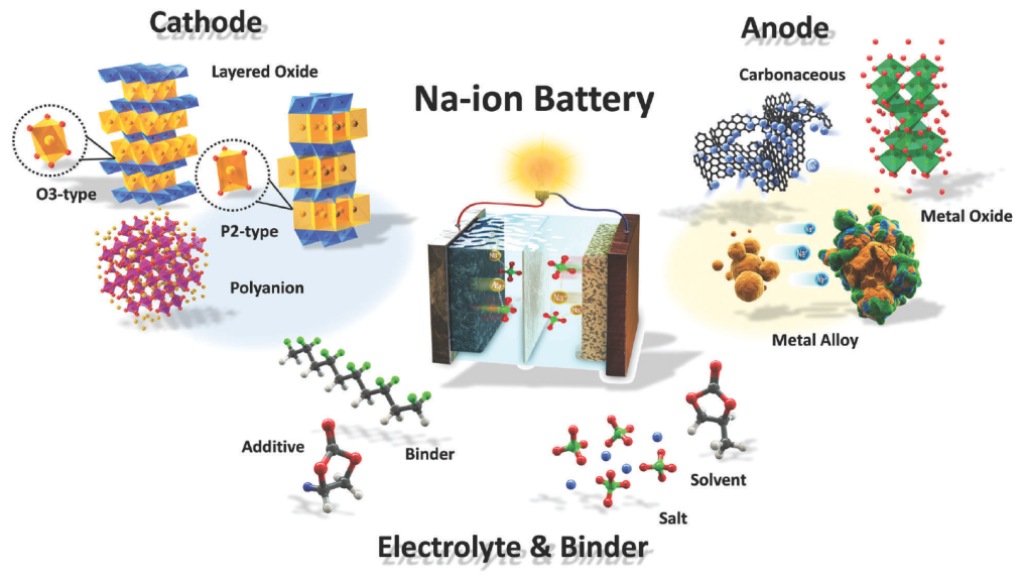
Illustration of a Na-Ion battery system
21 June 2017
Chemical Society Reviews: Sodium-ion batteries: present and future, Issue 46, Number 12, Page 3531, Scheme 1, doi:10.1039/C6CS00776G
Author: Tang-Yeon Hwang, Seung-Taek Myung, Yang-Kook Sun
Permission
(Reusing this file)
Open Access Review Article, license link: [1]
Further Reading:
https://www.cnbc.com/2026/06/09/gm-batteries-data-centers-energy-storage-business.html?
https://news.gm.com/home.detail.html/Pages/news/us/en/2026/jun/0609-sodium-ion-…
https://link.springer.com/content/pdf/10.1186/s44147-025-00668-y.pdf?
https://www.sciencedirect.com/science/article/abs/pii/S095758202400716X?