The CTIF Civil Defence Commission
 Advancing Civil Defence in Fire and Rescue Services:
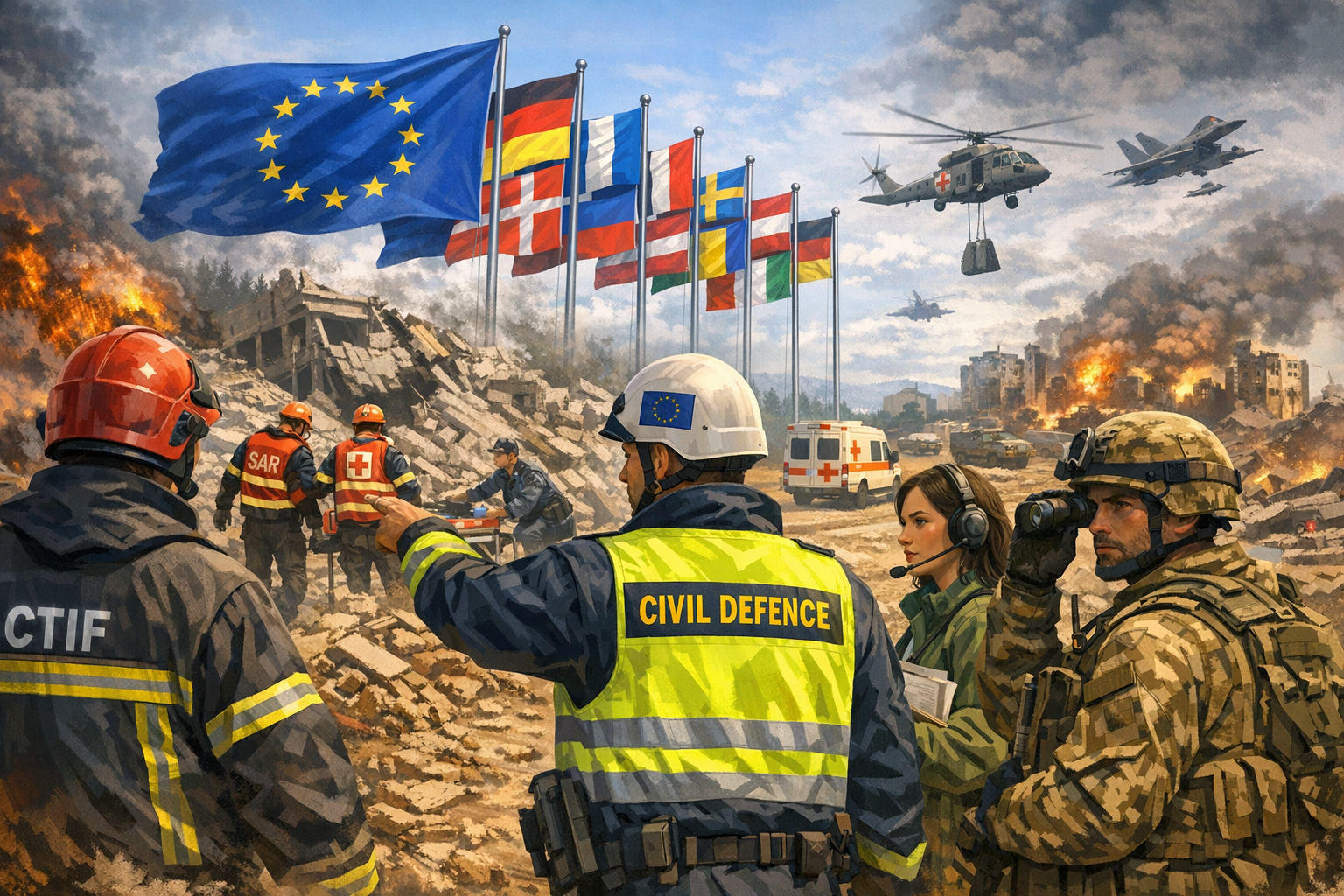
The CTIF Executive Committee has considered the recent and ongoing incursions into sovereign nations, including Ukraine, Poland, Qatar & Estonia and recognizes some member countries are urgently strengthening their civil defence capabilities.
A review of current and past events has exposed critical vulnerabilities in national emergency systems, particularly in the ability of fire and rescue services to operate effectively in complex civil defence scenarios involving armed conflict, infrastructure degradation, population displacement, and coordinated threats to civilian safety.
Civil defence readiness must encompass not only preparedness, response, and recovery, but also proactive mitigation strategies aimed at reducing risk, enhancing resilience, and safeguarding communities before crises emerge.
Fire and rescue services play a pivotal role in this continuum and must be equipped with the tools, training, and frameworks necessary to fulfill that role under increasingly volatile conditions.
The CTIF Executive Committee has therefore produced the Position Statement and Transitioning to Civil Defence paper and proposes to lead this effort a new Commission on Civil Defence be established.
The Commission’s objective will be to serve as the principal body for strategic coordination, policy development, and international collaboration through engagement with members to:
- Identify and disseminate best practices in civil defence operations;
- Assess current capabilities and gaps in mitigation, preparedness, response, and
recovery;
- Develop a flexible, scalable framework that can be tailored to the unique
structures and needs of each member nation; and
- Promote interoperability and resilience across borders.
The first meeting of this new working group was held online on February 24, 2026.
Participants emphasized the need for stronger coordination, training, and investment to prepare fire and rescue services for roles during armed conflicts and large-scale emergencies. The group agreed to develop a working paper outlining priorities and to launch a Europe-wide survey of civil protection capabilities, with the aim of strengthening preparedness and informing future policy discussions within the European Parliament and other European institutions.
Illustrations in this post are AI generated by Microsoft CoPilot from a prompt by Bjorn Ulfsson.