
Firefighters in continuous forest fire operations: Members and budgets stretched to the limit
Thank you for choosing Automatic Translation. Currently we are offering translations from English into French and German, with more translation languages to be added in the near future. Please be aware that these translations are generated by a third party AI software service. While we have found that the translations are mostly correct, they may not be perfect in every case. To ensure the information you read is correct, please refer to the original article in English. If you find an error in a translation which you would like to bring to our attention, it would help us greatly if you let us know. We can correct any text or section, once we are aware of it. Please do not hesitate to contact our webmaster to let us know of any translation errors.
55,000 Austrian firefighters were deployed this year to fight approximately 3,500 forest and vegetation fires. Since 2020, over €20 million of the fire service budget has been invested in specialized equipment.
The fire department is demanding funding for the necessary equipment and training for fighting forest fires and ensuring helicopter availability.
Extreme weather events are becoming more frequent. This doesn't necessarily mean more, but certainly more intensive, emergency responses. In 2026, starting in the spring, there was a surge in extremely demanding forest fire operations affecting all German states.
“Forest fires usually have a direct impact on our society. Intense fires endanger people and settlements, reduce the important protective function of forests, lead to increased erosion and result in steadily rising costs for firefighting as well as for necessary measures after the event,” states the action program “Wildfire Hotspot”, which was developed jointly with experts from a wide variety of fields and published in 2022 by the Federal Ministry of Agriculture, Forestry, Regions and Water Management.
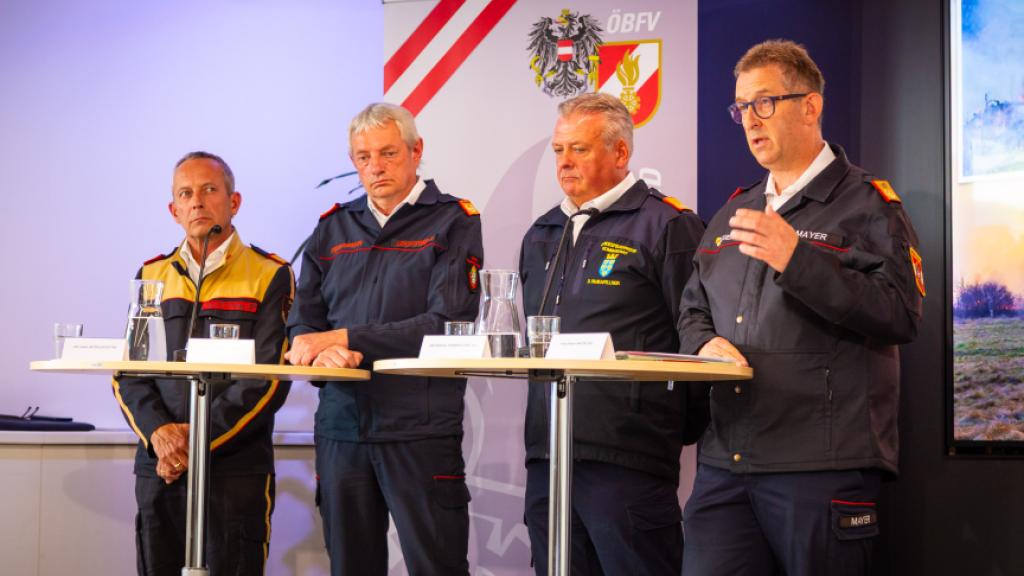
Photo Credit: Matias Seyfert
Cover Photo Above: From left to right: LBD Jakob Unterladstätter, LBD Reinhard Leichtfried, LBD Dietmar Fahrafellner, FPräs Robert Mayer
Austria-wide challenges despite regional differences
Firefighting in Austria falls under the jurisdiction of the nine federal states and is therefore subject to state law. However, forest fires are a federal responsibility. For forest fire suppression, the federal government utilizes the system of state and municipal fire departments.
Due to the varying topography, different challenges arise depending on the region. Difficult access in steep, rugged high-alpine and pre-alpine terrain – often in protected forest and spring conservation areas – places demands on emergency services, while elsewhere, unexploded ordnance poses an additional hazard. Forests are recreational areas and habitats for both humans and animals and play a vital role in regulating the climate. As the "green lungs" of our planet, we depend on rich vegetation, which is why, in addition to firefighting, the protection and management of forests are crucial for the future.
These energy-sapping operations across Austria are linked by the following facts:
- The rapid deployment of helicopters is consistently crucial to the operation. The faster the fire can be fought from the air, the faster it can be brought under control.
- The simultaneous occurrence of multiple deployments and the need to maintain reserves complicate resource allocation. Even though Austria has a comprehensive and seamless fire service system, specializations require separate consideration. The use of necessary specialized vehicles and helicopters, the increased training requirements for members, and the fact that operational readiness must be maintained in every municipality at all times can lead to bottlenecks.
- Slightly injured firefighters and property damage to vehicles and equipment cause additional personal, psychological, physical and financial strain.
- Events near settlements pose an immediate threat to the living space of the population, in addition to the threat to animals, which are at great risk in every forest fire.
- The ongoing drought is making it difficult to supply water across the entire area.
Fire Service President Robert Mayer: “For years, fire departments in Austria have focused heavily on managing natural disasters, with forest fires clearly taking center stage this year. It is high time to address these challenges nationally and secure them with sufficient funding and infrastructure. Over 260,000 firefighters, most of them volunteers, perform outstanding work, are ready for deployment around the clock, continuously train, practice as often as they can, and consider how we can continue to help our fellow citizens in the future. However, this requires a framework without which our fire service system will no longer function in its current form in the long term. In the case of forest fires, we believe the responsibility clearly lies with the federal government. Now it is time to move from talk to action. And quickly.”
Examples from 2026
- Lesachtal, Carinthia: 24 days of operation with around 2,000 firefighters, approximately 110 hectares affected
- Eisbach-Rein, Styria: 17 days of operation with around 2,500 firefighters, approximately 70 hectares affected
- Föhrenwald/St. Egyden, Lower Austria: 2 major fires on 18 days of operation, at times 800 firefighters simultaneously deployed, approximately 159 hectares affected
- Wildermieming and Virgen, Tyrol: multi-day operation with around 900 firefighters, approximately 10 hectares affected
- Lobau, Vienna: 100 emergency personnel from the Vienna professional fire brigade as well as additional forces from the state fire brigades of Vienna and Lower Austria, approximately 18 hectares affected
Tyrol's State Fire Chief Jakob Unterladstätter: "The forest fires in Virgen and Wildermieming have impressively demonstrated the particular challenges that alpine topography presents for our fire departments. Crucial to success is the interplay between ground-based emergency services and air support from rapidly available helicopters. At the same time, it has once again proven its worth that specialized personnel, expertise, and equipment can be quickly deployed across district and state borders wherever they are needed. However, these recent operations also demonstrate that we must continue to invest consistently in specialized equipment and training for our firefighters. Only in this way can we ensure a safe and effective response to such emergencies in the future."
State Fire Chief Reinhard Leichtfried (Styria): “The forest fire on the Mühlbachkogel, with 17 days of operations and a total of more than 2,500 firefighters deployed, was an exceptionally demanding operation. Steep and difficult-to-access terrain, the dynamic spread of the fire, and above all, the protracted extinguishing of numerous hotspots demanded enormous effort from our emergency services. At the same time, it demonstrated how important sound training, suitable equipment, and the coordinated cooperation of all deployed forces are. The experience gained in Eisbach-Rein is therefore an important basis for us to prepare even more effectively for future vegetation fires.”
The fire department invested over 20 million euros.
The increasingly intensive fight against forest fires has required a concerted effort from the state fire service associations since 2020. Over the past six years, more than €20 million from the fire service budget, supported by the forestry fund, has been invested. Key investment areas for all federal states include all-terrain vehicles, specialized equipment such as containers, backpacks, collapsible containers, entrenching tools, as well as lighter protective clothing and helmets, and water tanks for helicopters. The expansion of base fire stations and the air fire service, the provision of fuel for aircraft, and the training infrastructure at the state fire service schools have also required financial resources.
State Fire Chief Dietmar Fahrafellner (Lower Austria): “The effects of climate change are now hitting us fire departments hard in many areas of operation. Forest and vegetation fires are becoming more intense and present us with new challenges due to drought, heat, and difficult operating conditions. We must prepare for this with appropriate training, tactics, and modern specialized equipment. Our firefighters provide this service voluntarily and without pay, thus saving the public sector enormous costs. It is therefore all the more important to provide them with the best possible equipment for their operations. In Lower Austria, we have invested heavily in this area in recent years. However, such specialized and expensive equipment cannot be financed by the municipalities alone. Reliable support from the federal government will continue to be necessary so that we can keep pace with the changing operational scenarios and guarantee the safety of our emergency personnel.”
The fire department is well prepared, but…
Although the fire service system in Austria is well prepared for a multitude of challenges due to the density of fire departments, the high number of active members, and proactive preparation, professional planning for the future requires adjustments and the attention of the public authorities.
The Austrian Federal Fire Brigade Association, which as an umbrella organization represents all nine state fire brigade associations as well as the six municipalities with professional fire brigades, therefore demands, in the sense of a nationwide approach:
- Financing of the necessary equipment and training for forest fire fighting
Financing and maintaining the necessary equipment for fighting forest fires is not solely a municipal responsibility, and due to the significantly increased demand, it can no longer be covered by the budgets of fire departments, municipalities, and states. It is the federal government's responsibility to ensure funding for forest fire fighting. This includes specialized vehicles and equipment, personal protective equipment, and also the training needed to meet this particular challenge.
Furthermore, the long-standing demands on the Ministry of Finance remain in place:
Valorization of the special investment premium and the cost rates
Since 2022, the Austrian fire service has received €20 million annually in funding for "special investments." This amount has not been adjusted for inflation since then. The cost rates stipulated in the flat-rate tariff regulation also require evaluation.
Continued payment of wages for self-employed persons and farmers
A continued payment of wages, passed by the National Council in 2019, allows for compensation payments to certain companies under specific conditions. However, this payment can only be claimed if the emergency responder is an employee. The Austrian Federal Fire Brigade Association has been calling for its extension to the self-employed and farmers since its introduction, as well as for a less bureaucratic application process.
- Ensuring helicopter availability – both public and private
The nationwide, permanent availability of helicopters from the Ministry of the Interior and the Austrian Armed Forces, as well as the financing of private helicopters, urgently needs to be clarified and secured. An uncertain situation and the lack of guaranteed availability of high-performance helicopters in Austria, coupled with cost-cutting measures in training operations and the need to invest in additional equipment (e.g., water tanks), must not be allowed to continue.
The livestream and photos of forest fires in Austria can be found at: https://events.streaming.at/waldbrandsaison-20260923
For further information I am gladly at your disposal.
Best regards,
Andreas Rieger, MA
Fire Chief
Head of the ÖBFV Communications Department
Head of Department 1.3 – Public Relations and Awareness Raising
Head of the ÖBFV Competence Center for Communication
Managing Director ÖBFV Medien GmbH
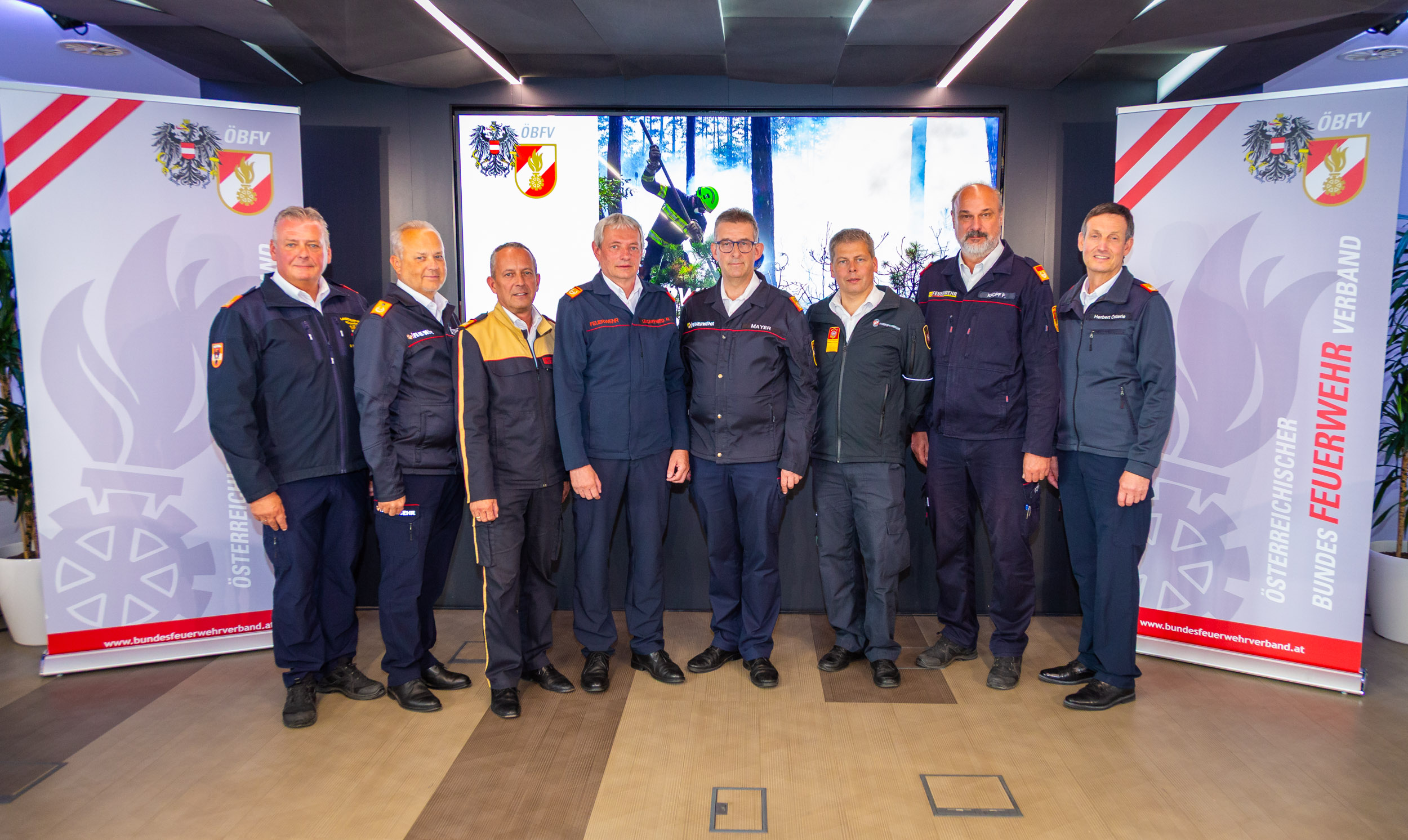
Photo Credit: Matias Seyfert
Photo Above: From left to right: LBD Dietmar Fahrafellner, FV President Günter Trinker, LBD Jakob Unterladstätter, LBD Reinhard Leichtfried, F President Robert Mayer, FV President Mario Rauch, LBD Franz Kropf, LBD Herbert Österle