
33 European MEPs push back on plans to buy Canadian firefighting aircraft, warning EU not to sideline its own firefighting industry
感谢您选择 Automatic Translation。目前,我们提供从英语到法语和德语的翻译,不久的将来还会增加更多翻译语言。请注意,这些翻译是由第三方人工智能软件服务生成的。虽然我们发现这些翻译大部分都是正确的,但并非每种情况下都完美无缺。为确保您阅读的信息正确无误,请参考英文原文。如果您发现翻译中有错误,希望引起我们的注意,请告诉我们,这将对我们大有帮助。我们一旦发现任何文字或章节有误,都会及时更正。如有任何翻译错误,请及时与我们的网站管理员联系。
A cross‑party group of 33 Members of the European Parliament is pressing EU leaders to explain - and potentially rethink - a plan for the Union and Canada to jointly purchase 50 De Havilland DHC‑515 water‑bombing aircraft, warning that the move risks undermining Europe’s own civil‑protection sovereignty and emerging aerospace industry.
This is a summary. The original letter and official Press Release has been attached.
In a letter sent on 7 October to European Commission President Ursula von der Leyen, European Council President António Costa, and European Parliament President Roberta Metsola, the Parliament’s Intergroup on Resilience, Disaster Management and Civil Protection argues that the draft EU‑Canada summit communiqué raises “more questions than it answers.”
According to the group, the draft statement foresees a large order of 50 aircraft by 2030. However, they point out, the text appears to provide no clarity on who will finance the purchase, how the aircraft will be allocated between the EU and Canada, or what industrial benefits Europe would receive.
“A decision of this magnitude demands seriousness, transparency and a genuine debate,” said Intergroup co‑chair Grégory Allione.
MEPs warn that relying heavily on Canadian‑built aircraft could leave Europe dependent on a partner whose wildfire season overlaps with its own, making shared fleets operationally unrealistic. They argue that Europe should avoid “outsourcing the production of the capabilities that protect our citizens.”
The signatories also stress that European alternatives already exist. France’s Hynaero Frégate‑F100, Spain‑Italy‑France partnerships, Kepplair Evolution conversion systems, Positive Aviation’s ATR‑72 amphibious program, and the Airbus A400M firefighting kit all represent viable solutions - many of which are entering testing or early industrialization.
Ordering 50 Canadian aircraft, they say, would “capture almost all European public demand for the decade,” depriving EU manufacturers of the orders needed to certify and scale their own platforms.
The MEPs issued three demands ahead of the summit:
- Clarify the financing, volume, and destination of the aircraft.
- Avoid commitments that lock in rescEU fleet needs beyond short‑term transitional capacity.
- Reserve procurement for aircraft designed and assembled in Europe, including in upcoming revisions of the Union Civil Protection Mechanism and the next Multiannual Financial Framework.
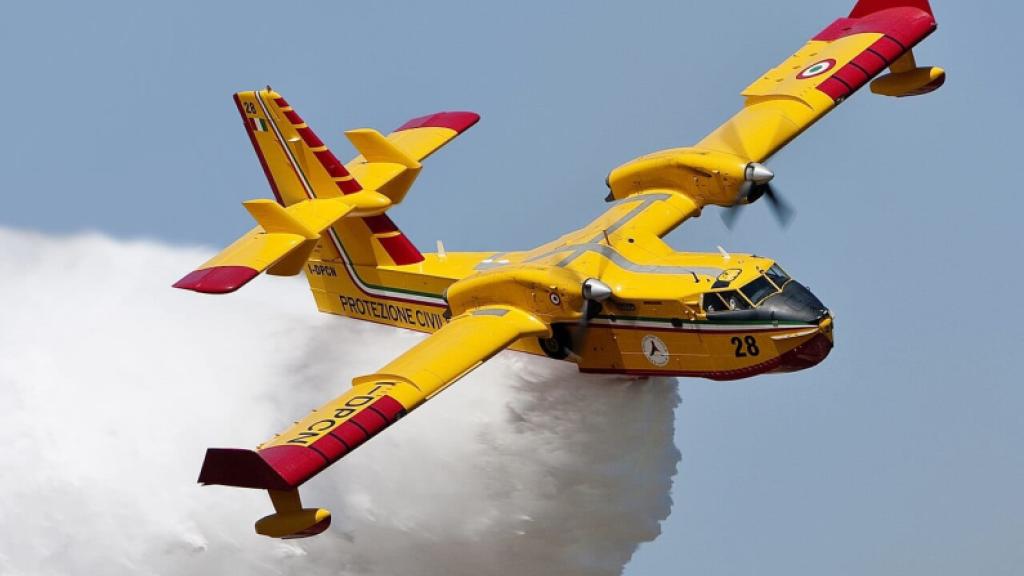
Photo Credit: Wikipedia Commons License - (https://maps.fire.josedacosta.net/en/aircraft/811)
A CANADAIR CL-415 SuperScooper · Croatian Air Force, 855th Squadron.
Photo by Maarten Visser · CC BY-SA 2.0 · Wikimedia Commons. The Canadair CL-415 and the De Havilland Canadair DHC-515 are a series of amphibious aircraft built originally by Canadair and subsequently by Bombardier and De Havilland Canada. The CL-415 is based on the Canadair CL-215 and is designed specifically for aerial firefighting, although it can perform various other roles, such as search and rescue and utility transport.