
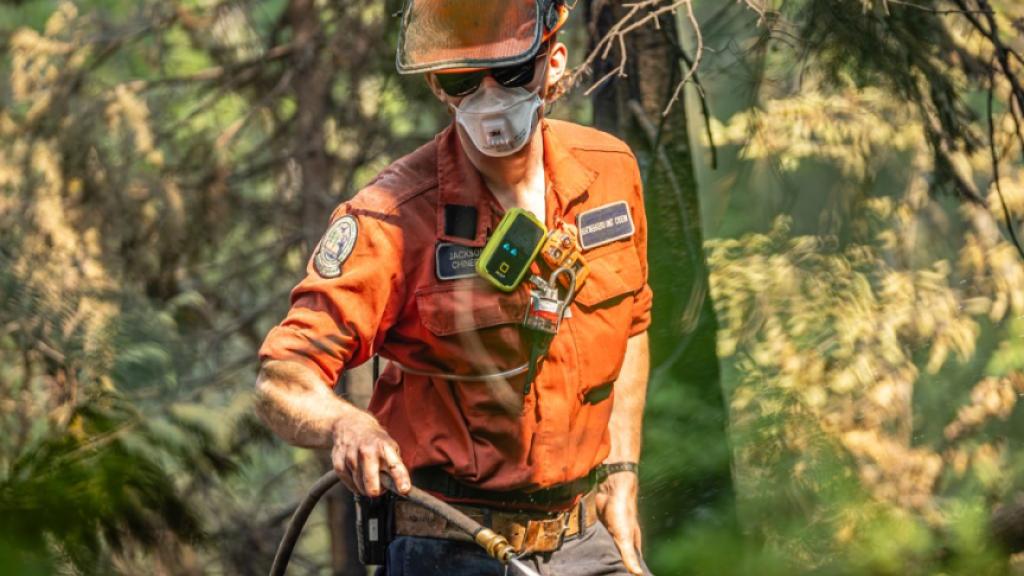
University study to be conducted on protecting firefighters from wildfire smoke - a particular challenge in rural Canada
Thank you for choosing Automatic Translation. Currently we are offering translations from English into French and German, with more translation languages to be added in the near future. Please be aware that these translations are generated by a third party AI software service. While we have found that the translations are mostly correct, they may not be perfect in every case. To ensure the information you read is correct, please refer to the original article in English. If you find an error in a translation which you would like to bring to our attention, it would help us greatly if you let us know. We can correct any text or section, once we are aware of it. Please do not hesitate to contact our webmaster to let us know of any translation errors.
WINNIPEG – As wildfire seasons become longer and more severe, Manitoba’s provincial government is facing renewed pressure to address the respiratory health risks posed to wildland firefighters who operate in heavily smoke-filled environments.
While the province has introduced voluntary measures, including the provision of disposable N95 masks and associated training, officials and experts acknowledge that mitigating the hazards of noxious gases and particulate matter remains a complex, ongoing challenge.
The Hazards of the Front Line
According to reporting by CBC News, and other Canadian media. wildland firefighters frequently endure exposure to a "toxic soup" of chemicals, fine particulates, and gases. A former Manitoba wildland firefighter, speaking on condition of anonymity due to fears of professional retribution, described the physical reality of the job: "At the end of the day, you're blowing your nose and it is all black."
The health implications are significant. In June 2022, the International Agency for Research on Cancer classified firefighting as a known human carcinogen. Data indicates that in Canada, more than 85 percent of firefighter fatality claims are attributed to cancer.
Current Provincial Measures
Manitoba Natural Resources Minister Ian Bushie stated that the province is committed to protecting staff. However, he emphasized that implementing widespread respiratory protection is not a straightforward solution. The government must balance safety against the physical demands of the job; wearing masks, for example, can exacerbate risks like heat exhaustion and cause difficulty breathing during periods of high exertion.
"The province wants to protect staff from the dangers of wildfire smoke, but the physical effects of wearing a mask have to be considered," Minister Bushie noted.
Currently, the Manitoba Wildfire Service provides training on mask usage, though wearing them is not mandatory. Occupational hygienist Drew Lichty, cited in CBC reporting, indicated that about half of eligible workers have opted to order the offered gear.
Limitations of Protective Equipment
Industry experts note that traditional urban firefighter equipment, such as oxygen tanks, is impractical for wildland crews due to the weight and limited supply. While N95 masks can trap 95 percent of damaging airborne particles when fitted correctly, they do not filter out many of the hazardous gases produced by wildfires, and they can hinder air intake during heavy exertion.
Currently, the standard operating procedure for many crews remains strategic positioning—placing firefighters upwind from the smoke whenever possible—and utilizing various suppression techniques to limit dust and smoke dispersion.
A Broader Context
Manitoba’s struggle reflects a wider issue across Canada. In 2023, the BC Wildfire Service began testing and offering specialized respiratory devices and masks to crews, while ongoing research—such as projects at the University of British Columbia—seeks to better understand the long-term respiratory impacts on those who battle wildfires.
Advocacy groups, including the Manitoba Government and General Employees Union (MGEU), have previously campaigned for better workplace protections. In 2024, the province proclaimed amendments to The Workers Compensation Amendment Act, expanding presumptive coverage for heart injuries and cancer to include forest firefighters, a move MGEU President Kyle Ross called "a long time coming."
As climate change continues to fuel more active fire seasons, the debate over how to adequately equip and protect those on the front lines is expected to intensify, with both crews and officials searching for solutions that safeguard long-term health without compromising immediate operational effectiveness.
Photo Credit: BC Wildfire Service
BC Wildfire Service crew member wearing 3M Aura N95 with Exhalation Valve. https://blog.gov.bc.ca/bcwildfire/reducing-exposure-respiratory-protection/
Further Reading:
https://www.cbc.ca/news/canada/british-columbia/respirators-wildland-firefighters-health-1.7168504
https://www.cbc.ca/news/canada/manitoba/wildfire-smoke-protection-firefighters-9.7157205