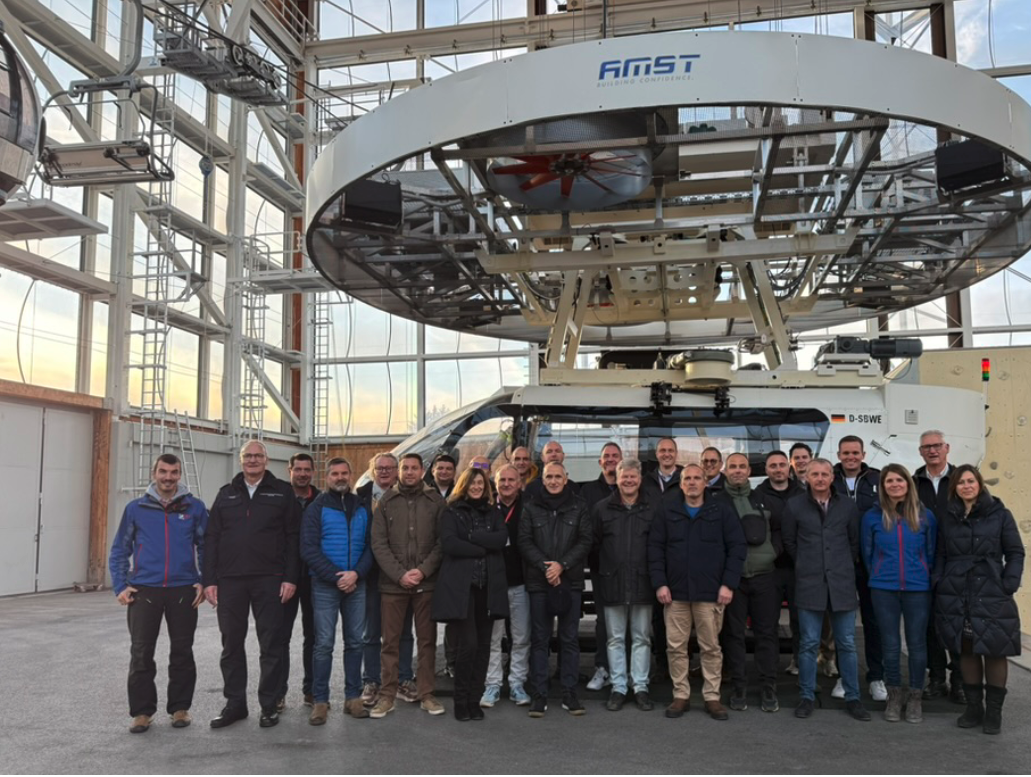
24 delegates from 12 nations met at the CTIF Forest Fire Commission in Bavaria
Thank you for choosing Automatic Translation. Currently we are offering translations from English into French and German, with more translation languages to be added in the near future. Please be aware that these translations are generated by a third party AI software service. While we have found that the translations are mostly correct, they may not be perfect in every case. To ensure the information you read is correct, please refer to the original article in English. If you find an error in a translation which you would like to bring to our attention, it would help us greatly if you let us know. We can correct any text or section, once we are aware of it. Please do not hesitate to contact our webmaster to let us know of any translation errors.
Twenty-four representatives from 12 nations met in Bavaria from December 9–12, 2025, to exchange experiences. Representing the DFV in the FFC are Mr. Eitzenberger and Dr. Cimolino (Chairman of the Working Group on Forest Fires in the DFV).
This report can also be downloaded as a PDF.
The Forest Fire Commission (FFC) of the CTIF held its autumn meeting in Bavaria from December 9–12, 2025. The CTIF Forest Fire Commission meets twice a year.
The 2025 autumn meeting was the first to be held in Germany. It took place in Unterschleißheim at the premises of the Bavarian State Fire Service Association (LFV Bayern).
The President of the German Fire Service Association (DFV), Karl-Heinz Banse, welcomed the participants together with the Chairman of the LFVBayern and FFC member, Hannes Eitzenberger.
The Vice President of the CTIF, Christoph Marchal (France), and the Chairman of the FFC and Director of the French Forest Fire Training Center in Valabré, Jean Marc Bedogni (France),expressed their sincere thanks for the preparations and hospitality.
Interregional deployment of units at the core of many many presentations
The overarching theme of the reports was again the joint, interregional deployment of units from various regions for vegetation fire suppression. The Finnish colleagues from the Finnish GFFF-V (Fire Brigade for Vegetation Fires-Interregional) once again had the longest journey in 2025, this time to Spain.
They traveled by plane, and, as in 2024 (when they traveled to Portugal), the equipment for the FI-GFFF-V was handed over on-site by the local colleagues in Spain. This worked well once again.Across all participating countries, the following key themes emerged:
- Due to changes in land use and the increasing integration of infrastructure (e.g., wind turbines, power lines and transformers, as well as radio masts) into nature, the topic of Wildland Urban Interface (WUI)is becoming even more important and is affecting increasingly larger areas.
- Fire analysis, incorporating weather data and soil conditions, and the implementation of the results in forecasting expected developments, is handled very differently in different countries.
Only a few currently offer dedicated training courses or workshops on this topic. However, experience with complex topography and extreme weather conditions has shown a significant need for such training.
Courses are currently offered in Spain, France, and an EU-funded course in Tuscany, among other countries. The EU recommendations on this topic are not well enough known:
https://civil-protection-knowledgenetwork. europa.eu/system/files/2023- 07/D2.2_guidelines_FireAnalyst_AFAN%20%281%29.pdf.
International courses on this subject are offered, for example, by the PauCosta Foundation and are, according to participants, very good, but they are fee-based:
https://www.paucostafoundation.org/en/training/
Unusually early fire season start in Belgium
- Belgium experienced an unusually early peak in the number of fires in May and also noted that the season has extended practically to the entire year. The preparedness of the Belgian fire brigades is to be improved.
- For Germany, Dr. Cimolino reported on experiences primarily from Gohrischheide and Tennenlohe (near Erlangen). In both cases, the fires originated with a similar history and progression to those in previous years.
Both are locations with significant munitions contamination and correspondingly complex firefighting operations.
- Furthermore, in consultation with the participating fire brigades from South Tyrol (Italy), Dr. Cimolino reported on the experiences with the major fires near Latsch (March 2025) and Prad (April 2025), for which he had organized an exchange of experiences with the local fire brigades in Prad in October 2025.
Due to the hillside location and weather conditions (strong winds), the fire spread very rapidly, and each blaze could only be extinguished by the rapid deployment of helicopters, including those carrying special extinguishing agents (wetting water or retardant).
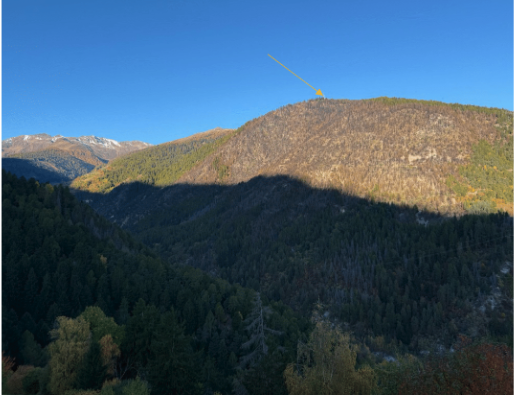
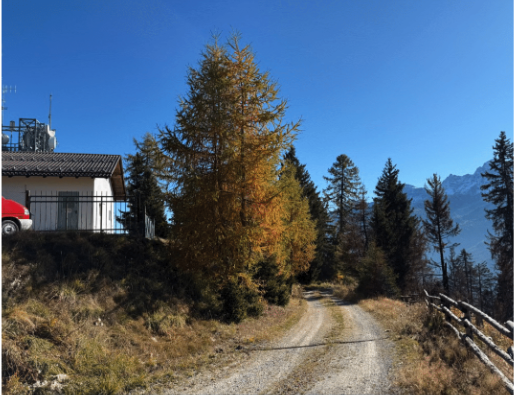
In the case of the fire at Großer Montoni (Prad), the blaze was stopped just short of the central transmission tower (TV, radio, tunnel radio (road, rail), emergency services radio, etc.) through the combined efforts of ground forces (e.g., their equipment flown in by helicopter) and airborne firefighters. This tower lacked redundancies.
- Finland reported unusual weather conditions in 2025 (record temperatures in April, below-average temperatures in May and June, and a record heat wave in July).
- On August 5, 2025, France experienced a massive fire near Ribaute in the south, with more than ten times the energy and significantly faster spread than previously seen. The largest fire since 1949 could not be actively extinguished despite enormous efforts (including backfire tactics and the use of 2,000 tons of fire retardant) and ultimately burned itself out in the damp vegetation (due to regional rainfall weeks prior).
It reached a heat energy level previously unheard of for a fire in Europe. A woman died in her home, and 13 people (including 11 emergency responders) required medical treatment.
- In Greece, the number of large fires (over 30 hectares) increased relative to the average, but the affected area decreased. The number of days with a high risk of forest fires has been rising for years. One of the largest fires (Chios Fire, August 12, 2025) was likely caused by power lines.
- For the first time, Croatia utilized the pre-positioning of firefighting units from the interior to the more severely affected coastal and 6 island areas within its own borders during the summer. This allowed for a significant reduction in the affected area despite a sharp increase in the number of fires. The units are coordinated by a central agency and redistributed as needed.
Due to its geographical location, Croatia does not participate in the EU Prepositioning Programme. However, it has responded to requests for assistance through the EU Community Procedure and by deploying RescEU units on several occasions.
Due to the densely populated coastal areas and the large number of tourists, the information and warning systems for the population and tourists need to be improved. Major problems arose with the lack of communication options between international units (especially aircraft).
This often necessitated direct communication via mobile phone between ground commanders and pilots. Therefore, the training of aircraft coordinators must be further improved and internationalized both internationally and within the EU. DC-ECHO has been organizing courses for several years to improve aircraft coordination and cooperation between air and ground.
There appears to be room for improvement in the implementation of these courses in some countries, as the necessary structures are lacking.
- Austria reported no unusual experiences. Training standards are to be further improved through centralized training and continuing education programs, as well as regular exchange of operational experiences.
- Following similar experiences to those in Croatia and Croatian operations abroad, the Czech Republic now always includes its own coordinators in all international deployments of Czech aircraft. These coordinators carry all necessary operational equipment for flight operations, including the required radios and personnel.
The Czech Republic has also participated in several other deployments abroad. (According to press reports, the Czech Republic is to receive the first three new Sikorsky S-70 Firehawk helicopters, which will also be cofinanced by the RescEU program.
An option for three additional used Blackhawk helicopters for the Czech police is also available.) - Hungary also reports a sharp increase in deployment numbers, albeit with a slightly reduced area of operation.
Lessons Learned Meeting of the European Commission on the 2025 Forest Fire Season in Paris (reported by the Hungarian colleague in attendance)
- Forest fire fighting was once again the most frequent reason for the activation of EU units. - Although there were fewer fires in Europe in 2025 compared to previous years, a record area was burned. The most frequent 7 activations of the EU Forest Fire Fighting Mechanism occurred at the end of July and in the second week of August 2025. - Prepositioning in the EU has proven effective.
In 2024, units from 14 offering countries were successfully deployed in 56 situations across 5 requesting countries. This will be continued. - Forest fires smaller than 30 hectares are not recorded in EU statistics.
- The number of aircraft via RescEU is to be significantly increased by 2030.
- A fire analyst will be involved in managing EU deployment requests in the future to provide better support. It is unclear how the information from this exchange of experiences is distributed across the countries. It often seems to get stuck at different levels, thus hindering information distribution and evaluation.
Reports from associated partners (companies):
Dr. Sthamer: Report on the use of special extinguishing agents in vegetation fire suppression, highlighting positive experiences with wetting agents for mop-up operations, which significantly reduced the duration of mop-up operations. Desautel: Reported on the varying requirements for emergency vehicles in different countries.
Airbus and CEREN (French testing institute for extinguishing agents in Valabré): Presentation of the A400M extinguishing agent drop kit. More than 20 tons of extinguishing agent (water, wetting agent, retardant) are possible. (Currently, the payload is 37 tons; a version with approximately 42 tons is under development.) Currently, there is no other way in Europe to drop such large quantities of extinguishing agent. In France, there has long been close research and training collaboration on the use of aerial extinguishing agents with aircraft pilots and ground commanders.
Airbus commissioned CEREN to investigate the extinguishing agent drop. To this end, 1500 measuring cups were set up next to the runway at Nîmes Airport, and drones were used to simultaneously test the drop behaviour in various trials (water and retardant). (Smoke generators on the ground simultaneously produced a small smoke cloud to give the pilots a visual indication of the ground wind conditions.) Airbus is seeking a training partnership with the school in Valabré, France, to offer its customers the necessary knowledge about the system.
The trials 8 commissioned by Airbus will be used for this purpose, and the results will not be shared publicly. One possibility for its use would be for the EU, for example through RescEU, to purchase and maintain several equipment kits. Ideally, these would be deployed at one or a few locations with A400M aircraft, as the pilots would need to be trained to execute the drops correctly. Perimeter Solutions: Presentation on the use of retardant, including an overview of experiences and the necessary equipment.
Following the proposals made by CTIF President Milan Dubravac at the meeting in Prague (December 24), the FFC is working on several topics to provide its members with basic recommendations, as the same problems and discussions are prevalent everywhere. Possible examples of topics include:
1. Personal Protective Equipment (PPE)
2. Unexploded Ordnance (UXO) = primarily unexploded ordnance
3. (Special) extinguishing agents in vegetation fire suppression
4. Vegetation: measures for hazard prevention and risk minimization
5. Wildland/Urban/Infrastructure Interface (WUI)
6. Mop-up operations
The following facilities were visited during the conference:
- Munich Fire Department: Fire Station 4 with the control center and the city center fire station
- Geretsried State Fire Academy
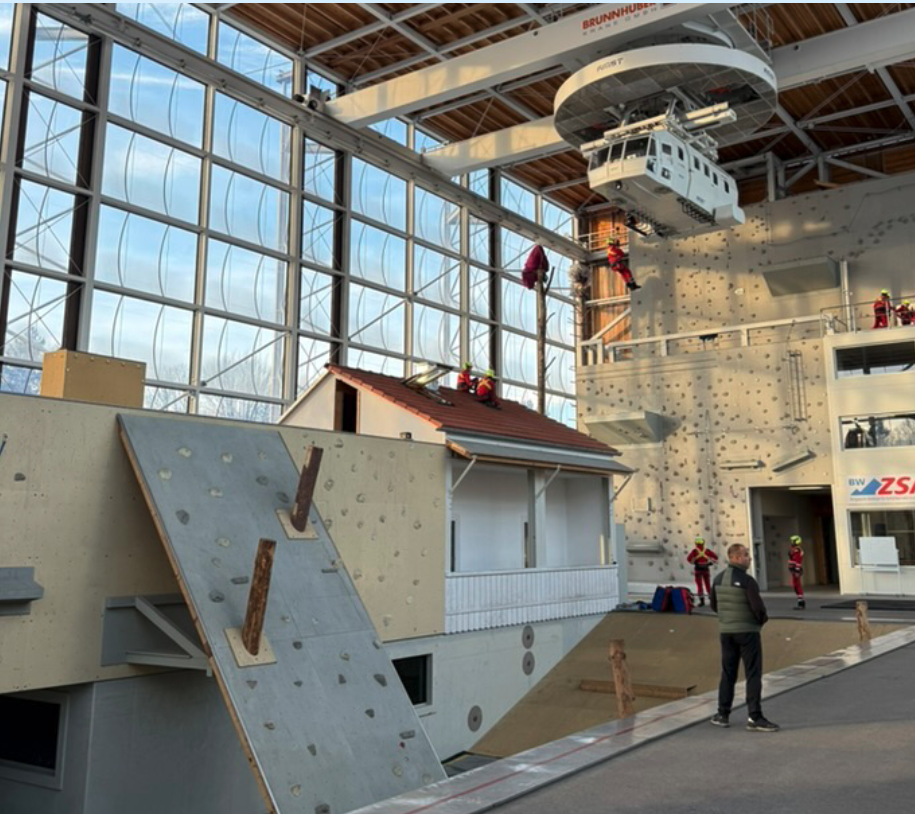
- Bavarian Mountain Rescue Service Center for Alpine Safety in Bad Tölz
- Unterschleißheim Fire Department
- Iffeldorf Fire Department
Photos:
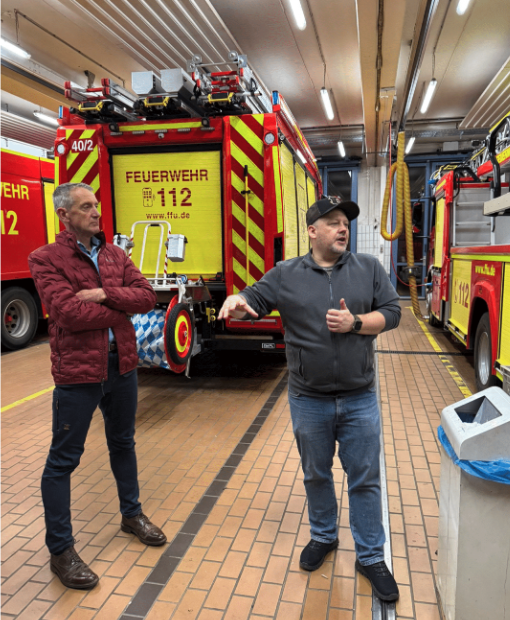
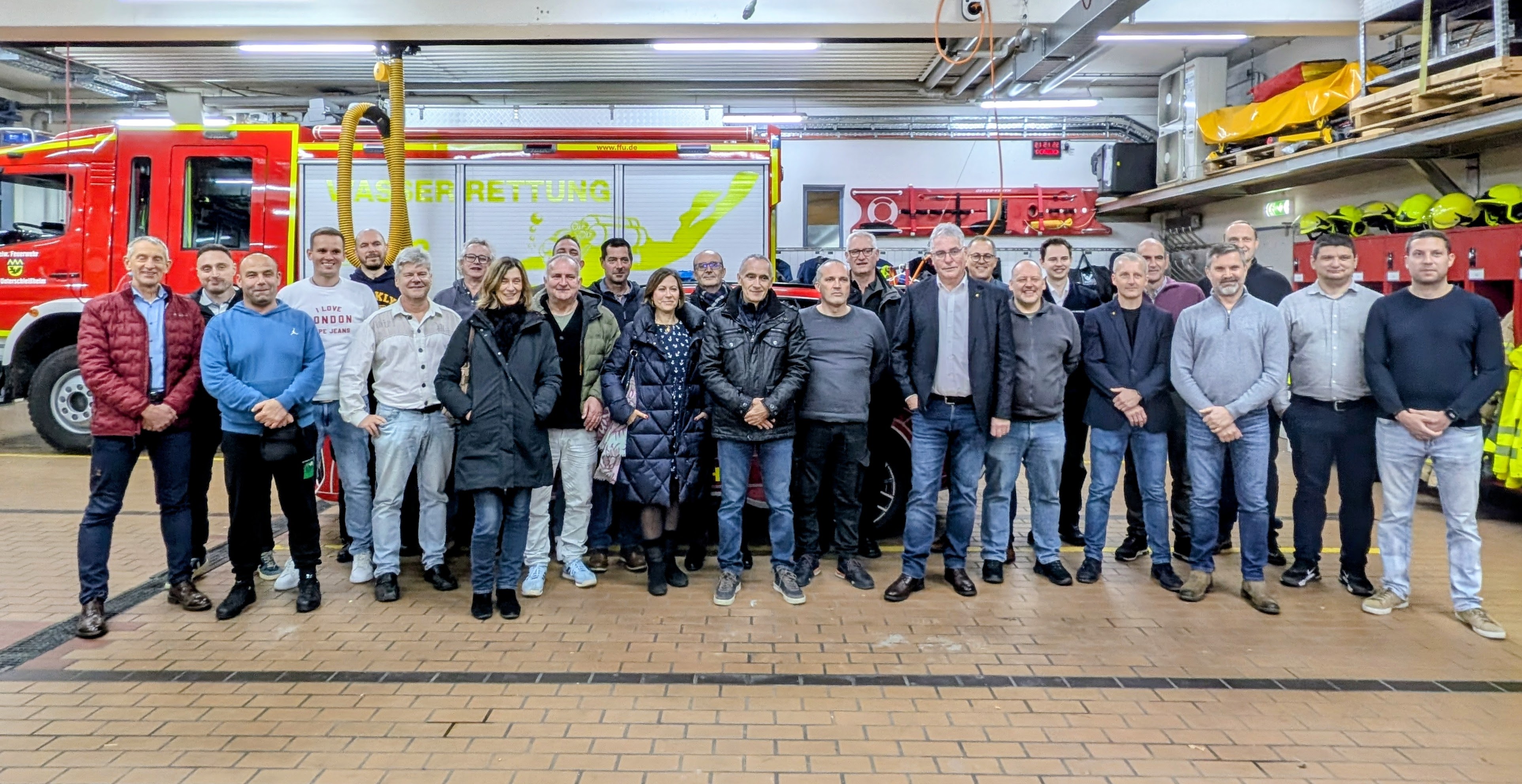
Figures 1a and b: CTIF FFC at the Unterschleißheim Fire Department (near Munich). Markus Brandstätter, Chairman and Commander of the Unterschleißheim Fire Department, explains the department's tasks and vehicles to the CTIF FFC colleagues in fluent English.
CTIFVice President Christoph Marchal, standing next to him, expressed his sincere thanks for the explanations and support during the meeting. (Photos: CTIF; Dr. Cimolino)
Figures 2a and b: During the fire on the Großer Montoni mountain in Prad (South Tyrol, Italy), the forest fire could only be stopped with the help of firefighters and the immediate deployment of several helicopters to transport personnel, equipment, and water, as well as the use of a retardant agent just a few trees away from the transmitter site.
The transmitter site has no redundancies, and if the fire had occurred, radio communications for roads(including parts of the Brenner motorway!), railways, as well as emergency services, radio, and television in parts of South Tyrol would have been disrupted. (Photos: Dr. Cimolino)